
CANADA VISA PHOTO REQUIREMENTS AT A GLANCE
Follow these key rules to make sure your photo is accepted.
DIMENSIONS
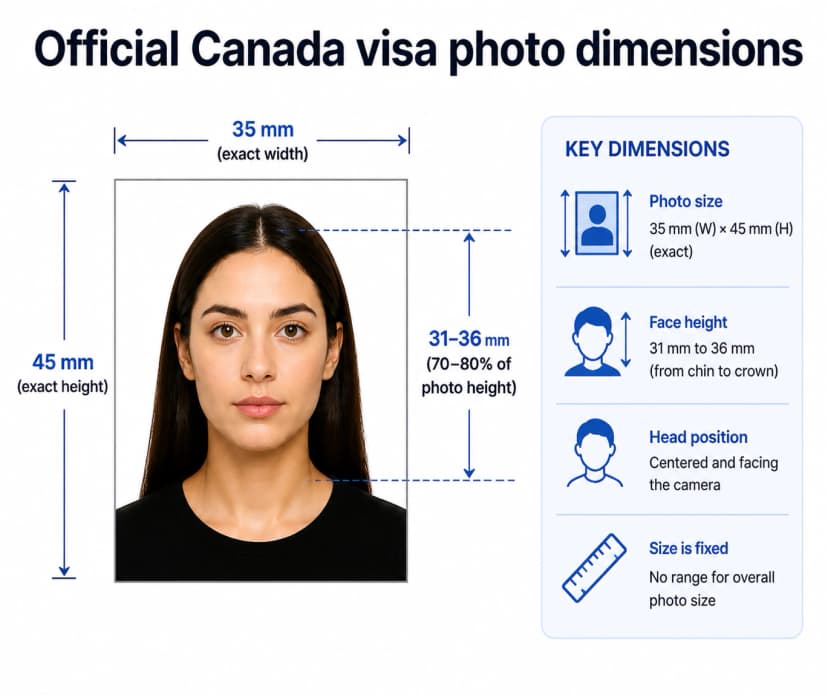
Photo size: 35 × 45 mm
Head size: 31 – 36 mm
FACE POSITION & SIZE
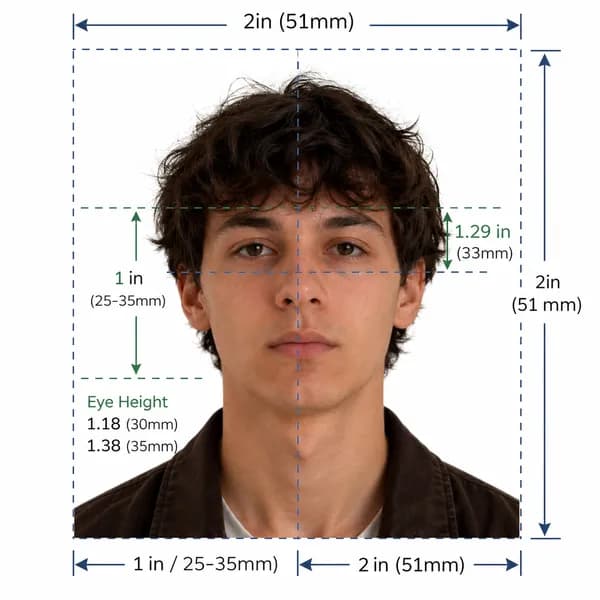
Keep head centered looking straight into the camera. Face height must measure 31 – 36 mm (68–80%).
BACKGROUND
Important Note
Canada IRCC requires digital photos to be in JPEG format, at least 420 × 540 pixels in resolution, and under 4 MB in file size. Glasses are strictly forbidden in Canadian visa and passport photos since 2020.
Official Compliance Guarantee
Our AI system validates your photo against official Canadian visa photo requirements. Get 100% compliant photos or we'll help you fix it.
Canada Official Photo Specifications
Canadian Passport Order (SI/81-86) & IRCC Photo Specification Standards
Official government rule for application approvalImmigration, Refugees and Citizenship Canada (IRCC)
Application context: Canada Visa Applications
Quick reference: Canada visa photo specifications
Review all official photo specifications required by Canada embassies, consulates, and visa application centres worldwide.
| Specification | Requirement |
|---|---|
| Photo size (Paper) | 35 × 45 mm (1.38 × 1.77 in) |
| Digital resolution | 413 × 531 px @ 300 DPI |
| Face height | 31 – 36 mm (68–80% of total height) |
| File format & size | JPEG, 240 KB – 5 MB |
| Background colour | White or Light Gray |
| Expression | Neutral expression, mouth closed, eyes open |
| Glasses policy | Permitted with thin, non-reflective frames |
| Recency | Taken within the last 6 months |
Official Canada visa photo dimensions
IRCC guidance specifies that visa and passport photos must be exactly 35 mm wide and 45 mm high, with the face measuring 31 mm to 36 mm from the bottom of the chin to the top of the head (the crown). Unlike some other countries, Canada does not provide a range for the overall photo size — the dimensions are fixed at 35 × 45 mm.
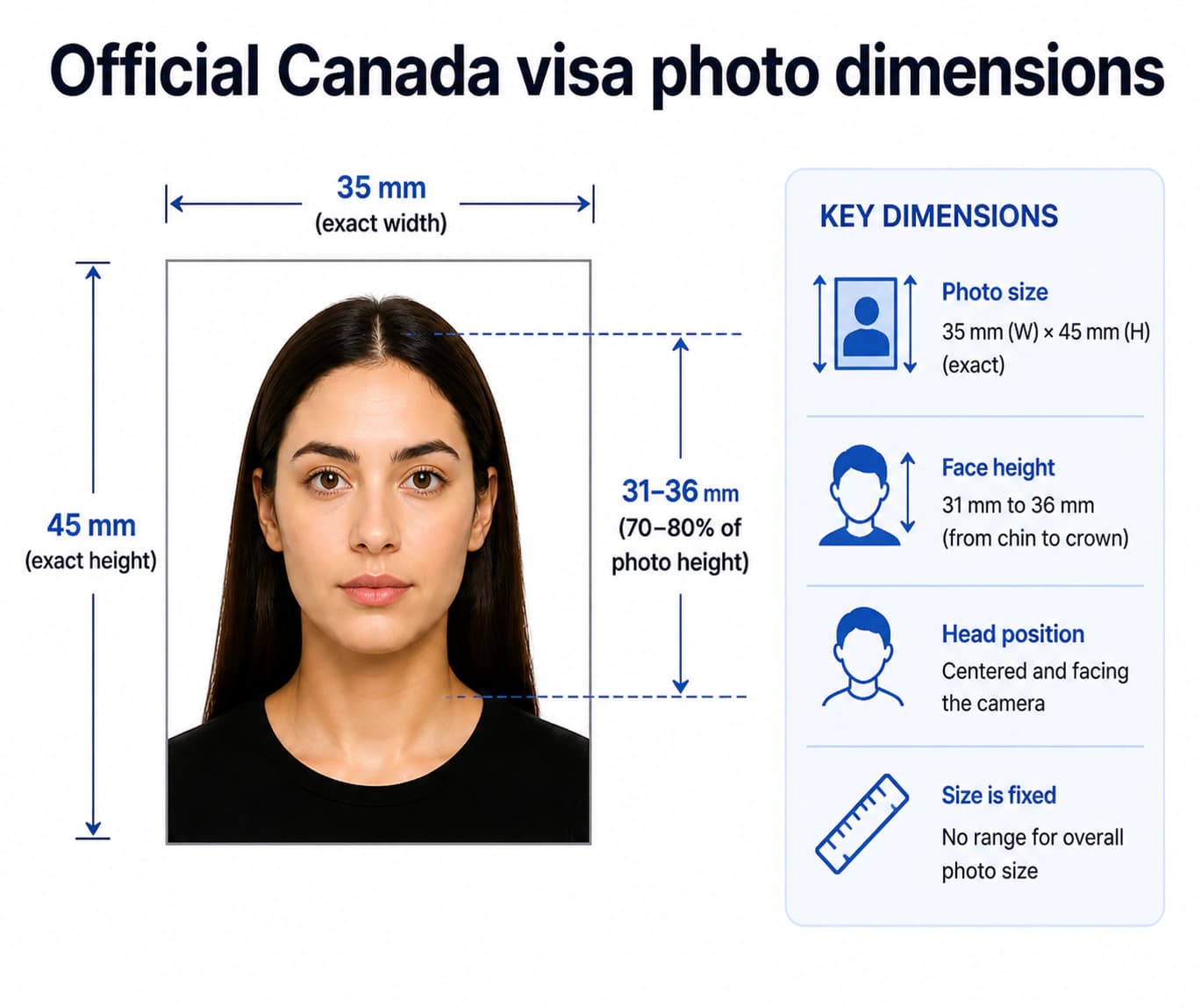
Many applicants assume Canada uses the same 2 × 2 inch (51 × 51 mm) square format as the United States. This is incorrect. Canadian visa photos are a portrait rectangle — 35 mm wide by 45 mm high — and submitting a square photo will result in rejection.
Canada visa photo size in mm, cm, and inches
| Unit | Width | Height | Face height |
|---|---|---|---|
| Millimetres (mm) | 35 mm | 45 mm | 31 – 36 mm |
| Centimetres (cm) | 3.5 cm | 4.5 cm | 3.1–3.6 cm |
| Inches (in) | 1.38 in | 1.77 in | 1.20–1.42 in |
| Pixels (px @ 300 DPI) | 413 px | 531 px | 361–425 px |
Too complicated? Let our AI handle it.
Upload a selfie and our AI will automatically crop, size, and replace the background to validate against official government requirements.
Need a Canada Passport Photo instead?
View official biometric specs, size rules, and digital upload requirements for Canada passport applications.
Print vs. digital: what changes between paper and online applications?
If you apply for a Canadian visa or permit through the IRCC online portal, you upload a single digital JPEG file. If you apply through a paper form or attend an in-person appointment at a visa application centre, you typically need two identical printed photos. The face position, expression, and background rules are identical for both — only the format and output specifications differ.
| Aspect | Print (Paper form) | Digital (Online) |
|---|---|---|
| Dimensions | 35 × 45 mm | 413 × 531 px |
| Format | Colour print on photo paper | JPEG (240 KB – 5 MB) |
| Background | White or Light Gray | White or Light Gray |
| Resolution | Min 300 DPI | 413 × 531 px (300 DPI) |
| Expression | Neutral expression, mouth closed, eyes open | Neutral expression, mouth closed, eyes open |
Background requirements for Canada visa photos
The background must be plain white — not off-white, not cream, not light grey. It must be evenly lit with no shadows, patterns, gradients, or objects visible. The white background must clearly contrast with your face, hair, and clothing. Do not use a background removal tool to replace a coloured background with white — retouching of any kind is not permitted and the processing system can detect composite images.
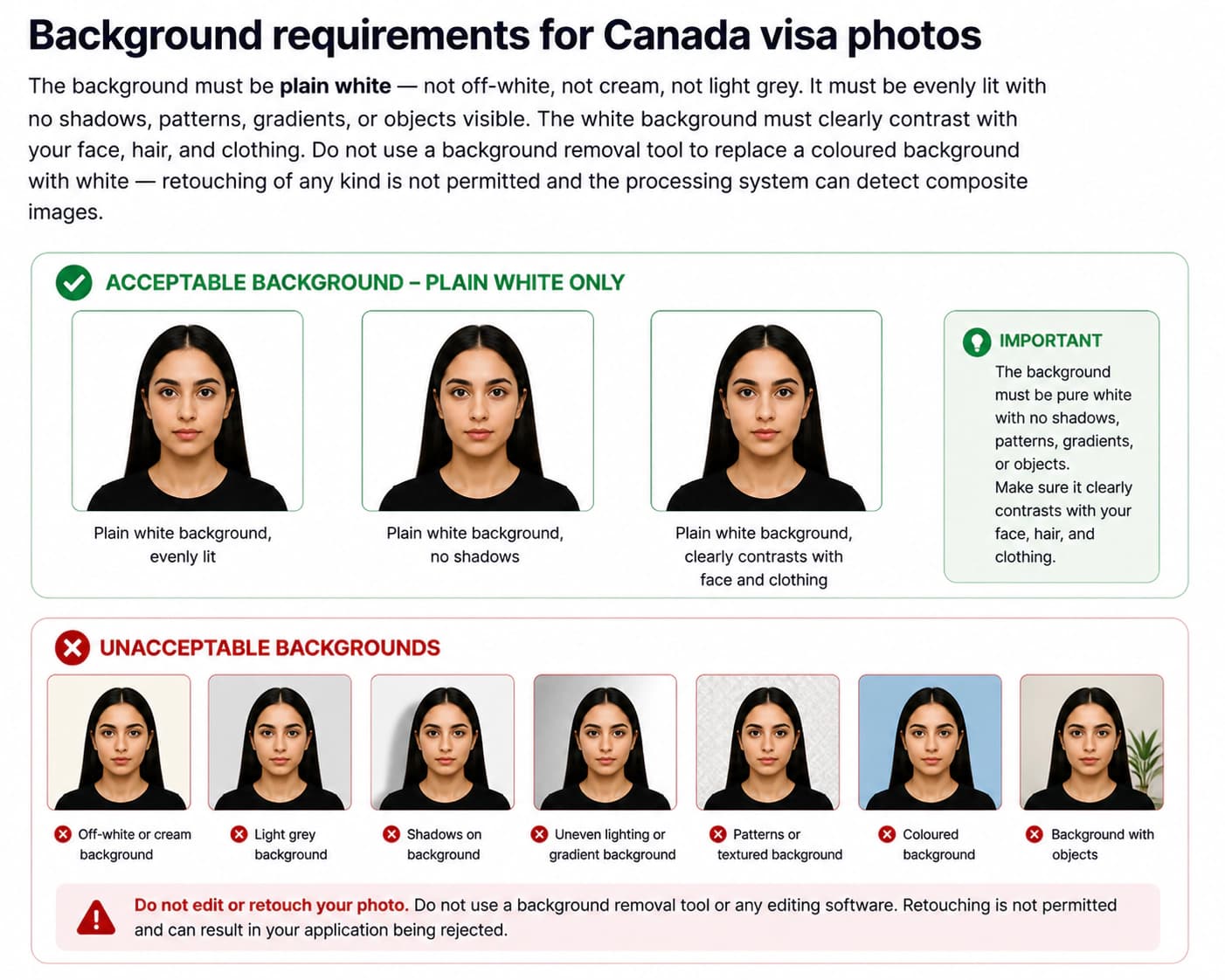
This is one of the most common areas of confusion for applicants from other countries: many nations (including Australia and the UK) accept light grey backgrounds, but Canada specifically requires white. If in doubt, test your background by holding a sheet of plain white printer paper next to it — the background should match the paper.
Face position, expression, and lighting requirements
Your face must be centred in the frame, looking directly into the camera lens with your head level and upright. Both ears should be visible and unobscured. Hair must not cover the sides of your face, forehead, or eyes. Your eyes must be fully open and looking straight at the lens. Your mouth must be closed with a neutral, relaxed expression — no smiling, frowning, or raised eyebrows.
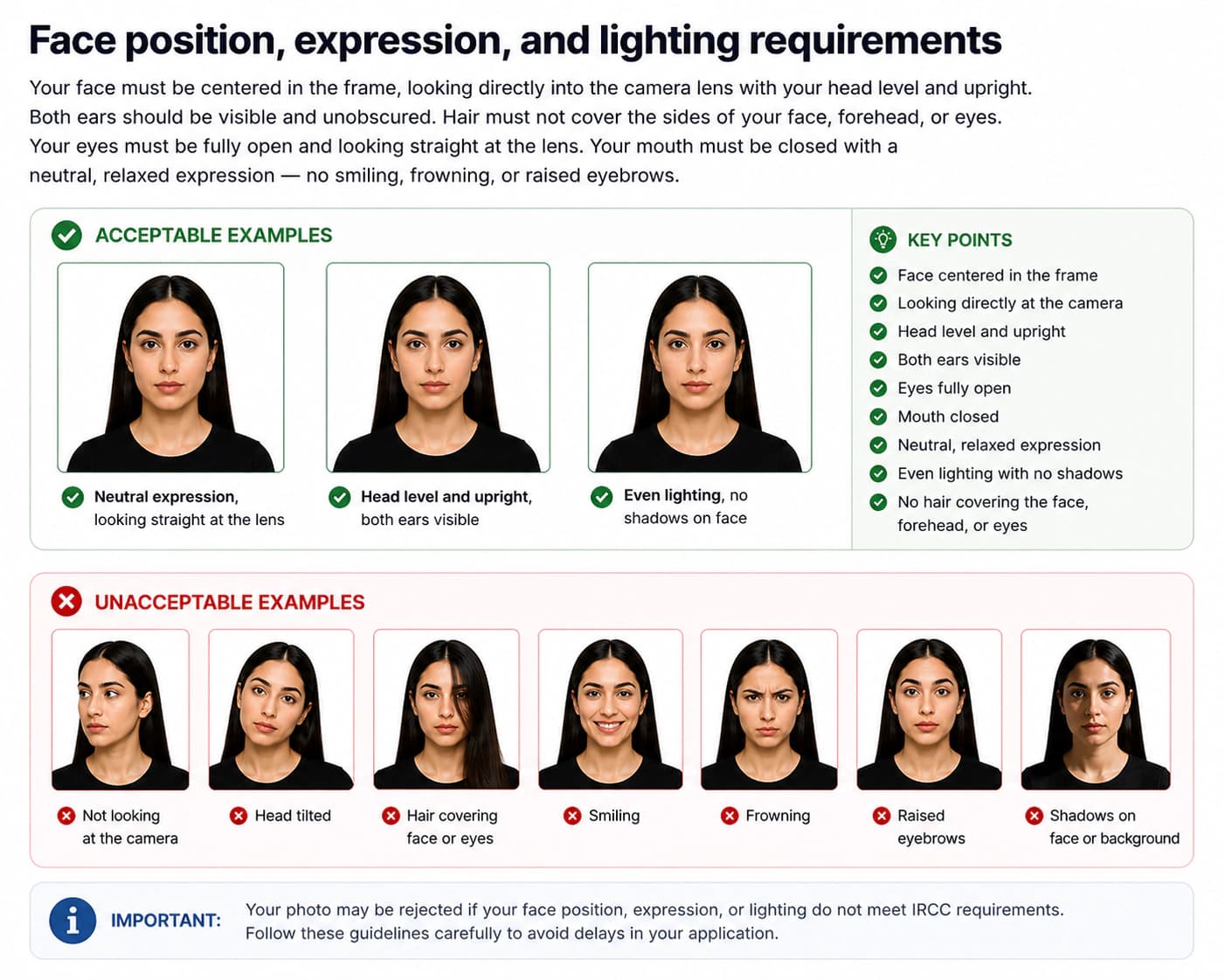
Lighting must be uniform and diffused. There should be no shadows on your face, under your chin, or on the white background. Your natural skin tone must be faithfully represented — avoid direct flash, which creates harsh highlights, red-eye, and shadows. Use diffused natural window light or two balanced artificial light sources at equal height on either side of your face.
Glasses policy for Canada visa photos
Glasses are not permitted in Canadian visa or passport photos under any circumstances. IRCC removed all exceptions in 2020 to improve biometric processing accuracy and eliminate ambiguity. Unlike some other countries, Canada does not offer a medical certificate exemption — glasses must be removed regardless of the reason for wearing them.
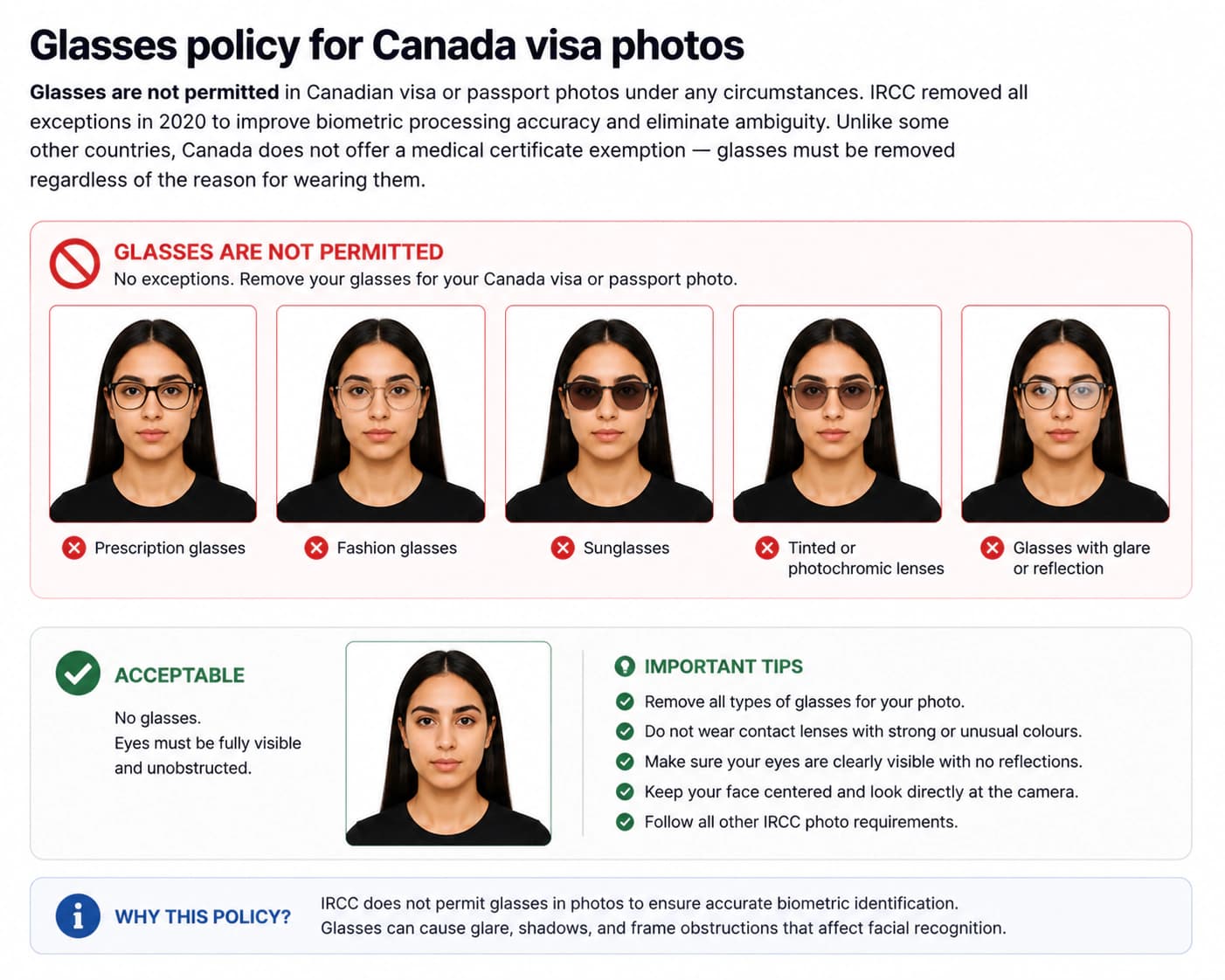
This is a firm and absolute rule. Even clear frames with no tint, frames that do not cover the eyes, or prescription eyewear needed for medical reasons must be removed before the photo is taken. If you cannot remove your glasses safely, seek assistance from a professional photo studio or contact IRCC directly.
Canada visa photo checklist: do's and don'ts
Double check these common pitfalls to ensure your photo is not delayed or rejected at the IRCC portal or visa application centre.
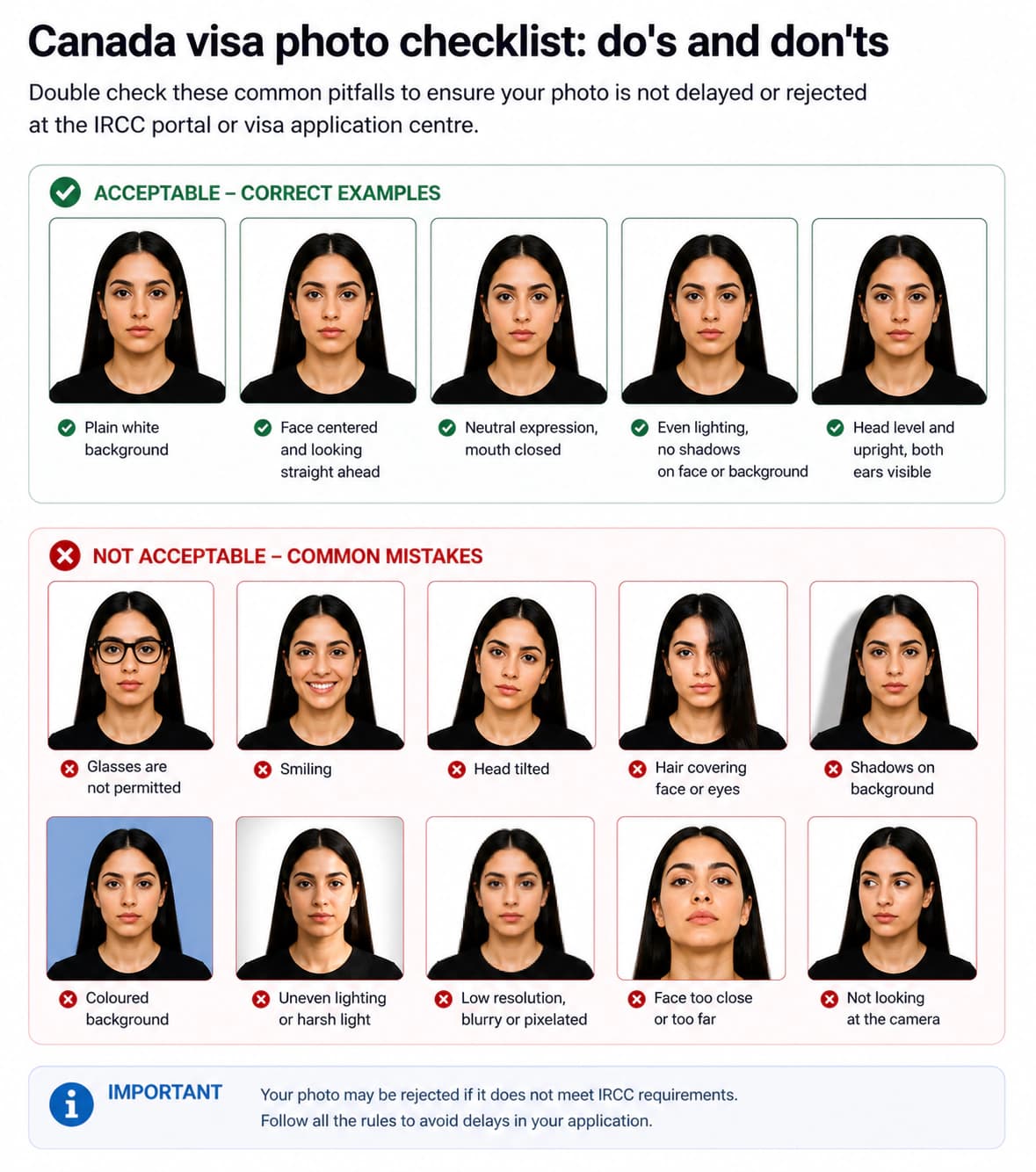
DO
- Use a plain white background with no shadows, textures, or patterns
- Ensure your face is centred, forward-facing, and fully visible from chin to crown
- Keep your eyes fully open and looking directly at the camera
- Maintain a neutral expression with your mouth closed
- Use even, diffused lighting with no shadows on your face or background
- Include the tops of both shoulders and upper chest in the frame
- Ensure hair does not cover the edges of your face or obscure your eyes
- Use a JPEG file under 4 MB and at least 420 × 540 px for online submissions
- Have the photo taken within the last 6 months to reflect your current appearance
- Wear everyday clothing appropriate to the season — nothing that blends into the white background
DON'T
- Wear glasses — they have not been permitted in Canadian visa or passport photos since 2020
- Smile, tilt or turn your head, or allow your eyes to be partially closed
- Use a coloured, patterned, off-white, or cream background
- Retouch, filter, or digitally alter the photo in any way
- Submit a scan of a printed photo or a phone photo of another photo
- Upload a file above 4 MB or below the minimum 420 × 540 px resolution
- Wear hats, beanies, or fashion headwear (religious and medical coverings excepted)
- Allow hair, jewellery, or accessories to cover your eyes or the sides of your face
- Use a photo older than 6 months
- Use a black-and-white, sepia, or heavily compressed image
How to take a correct Canada visa photo at home (step-by-step)
Following these six steps will produce a photo that meets IRCC requirements for both paper and digital submissions without needing to visit a professional studio.
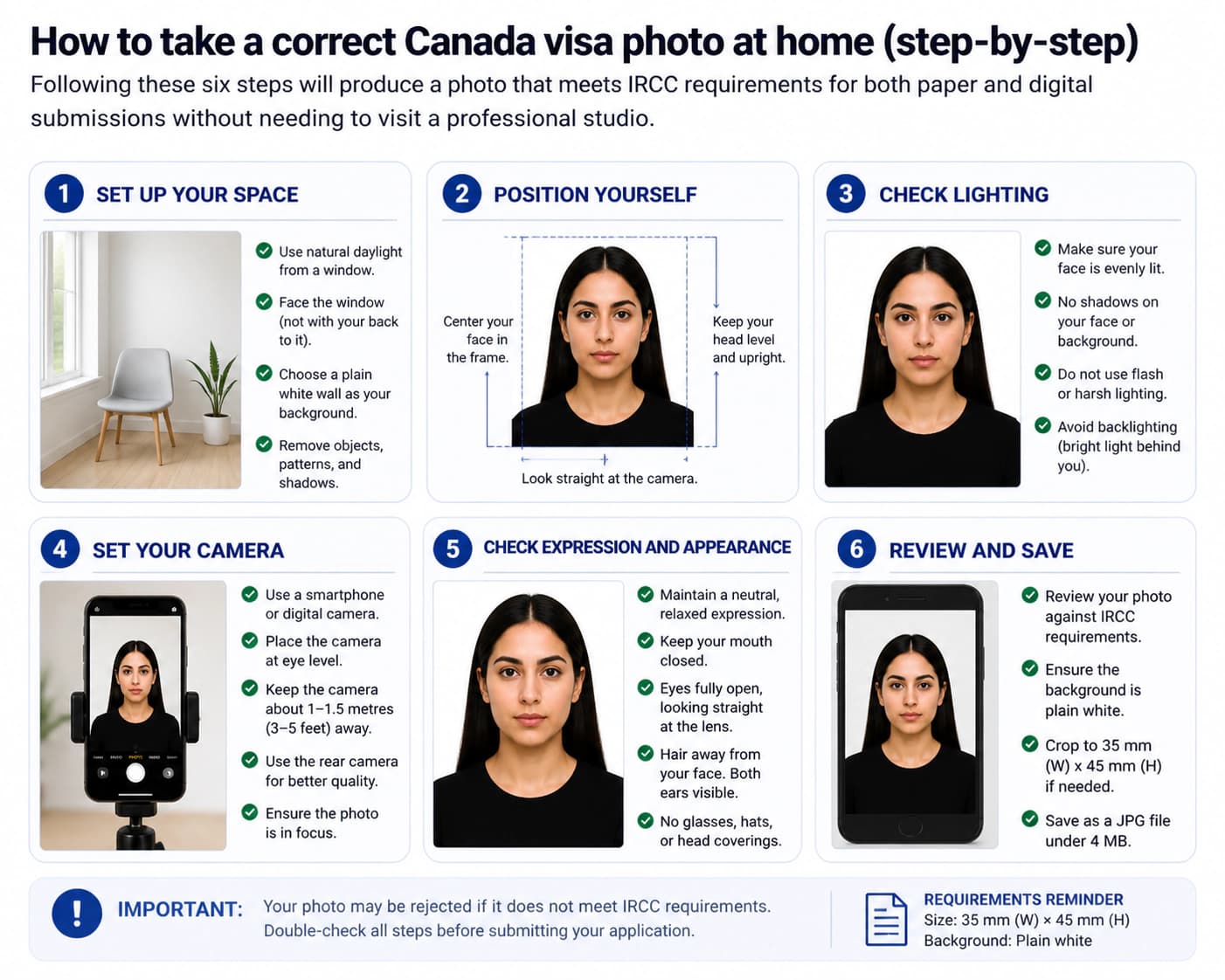
Prepare a plain white background
Hang a white sheet or stand in front of a plain white wall. Ensure it is evenly lit so there are no shadows, creases, or colour gradients visible behind you. The background must be pure white — off-white and cream shades are routinely rejected.
Set up balanced lighting
Use natural daylight from a large window or two artificial lights at equal height positioned on either side of your face. Avoid direct flash, which causes harsh highlights and red-eye. Even lighting prevents shadows forming on your face or the white background.
Position your head and body correctly
Face the camera directly with your head level and upright — no tilt, no turn. Your shoulders and upper chest should be visible at the bottom of the frame. Position yourself roughly 45–60 cm from the camera. Both ears should be visible and your face fully centred.
Take the photo
Open your eyes fully and look straight into the lens. Keep a neutral expression — mouth closed, no smile or frown. Remove glasses before taking the shot. Ask someone else to take the photo for a sharper, better-composed result than a selfie.
Crop and size the image
For paper submissions, crop to exactly 35 × 45 mm at 300 DPI minimum. For online submissions, resize so the image is at least 420 × 540 pixels and export as a JPEG file under 4 MB. Ensure the face occupies 31–36 mm of the 45 mm height.
Check before submitting
Verify the background is pure white and shadow-free, no glasses are visible, eyes are open and expression is neutral, hair does not cover your face edges, and the JPEG file meets the size and resolution requirements before uploading to the IRCC portal.
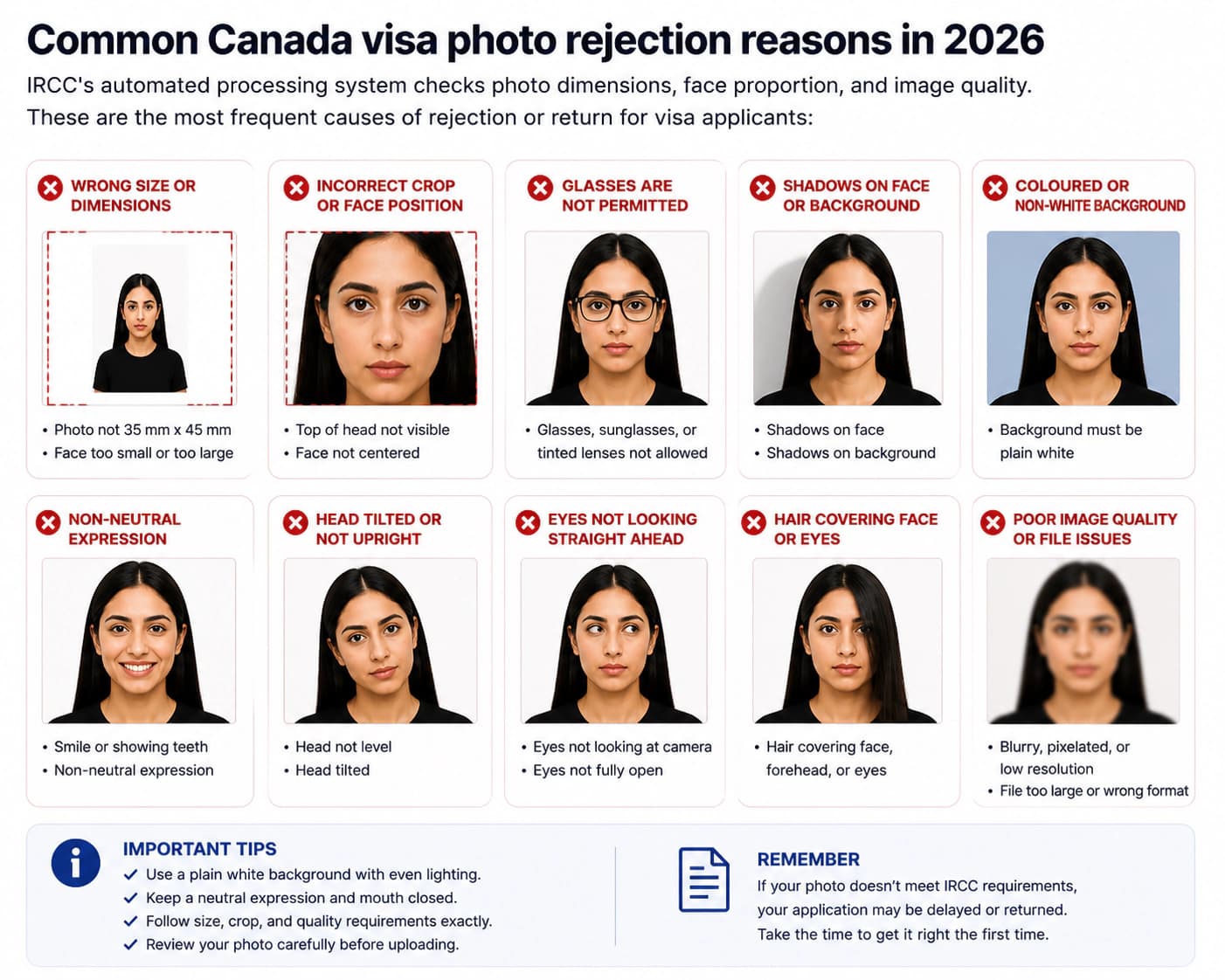
Common Canada visa photo rejection reasons in 2026
IRCC's automated processing system checks photo dimensions, face proportion, and image quality. These are the most frequent causes of rejection or return for visa applicants:
Non-white background
Canada strictly requires a plain white background. Off-white, cream, light grey, or any tinted background will be rejected. Natural or artificial shadows on the background are also grounds for rejection.
Glasses in the photo
Since 2020, glasses are not permitted in Canadian visa or passport photos without exception for standard applicants. Even clear frames will cause rejection during automated processing.
Wrong face height proportion
Your face from chin to crown must measure 31–36 mm of the 45 mm total height. A face that is too small (distant shot) or too large (close crop) will fail automated face-proportion checks.
Scan of a printed photo
Uploading a scanned version of a printed photo, or a phone photo taken of another photo, will fail quality checks. The digital file submitted must be the original capture from a camera.
Non-neutral expression
Smiling, open mouth, raised eyebrows, squinting, head tilt, or partially closed eyes are all detected by IRCC\
Image below minimum resolution
The online portal requires a minimum of 420 × 540 pixels. Images below this threshold or above 4 MB will not be accepted. Always check dimensions before uploading.
Photo older than 6 months
IRCC requires a recent likeness taken within the past 6 months. If your appearance has changed significantly — for example due to surgery, major weight change, or ageing — use a new photo.
Retouching or digital alteration
Any digital editing — including skin smoothing, blemish removal, brightness adjustment, background removal and replacement — is not permitted. The photo must be the original, unaltered capture.
Canada visa photo requirements for babies and children
Children of all ages — including newborns — must have their own separate visa photo and cannot share a photo with a parent or guardian. The child must be photographed alone, with no other person, hand, toy, pacifier, chair back, or any other object visible in the frame.
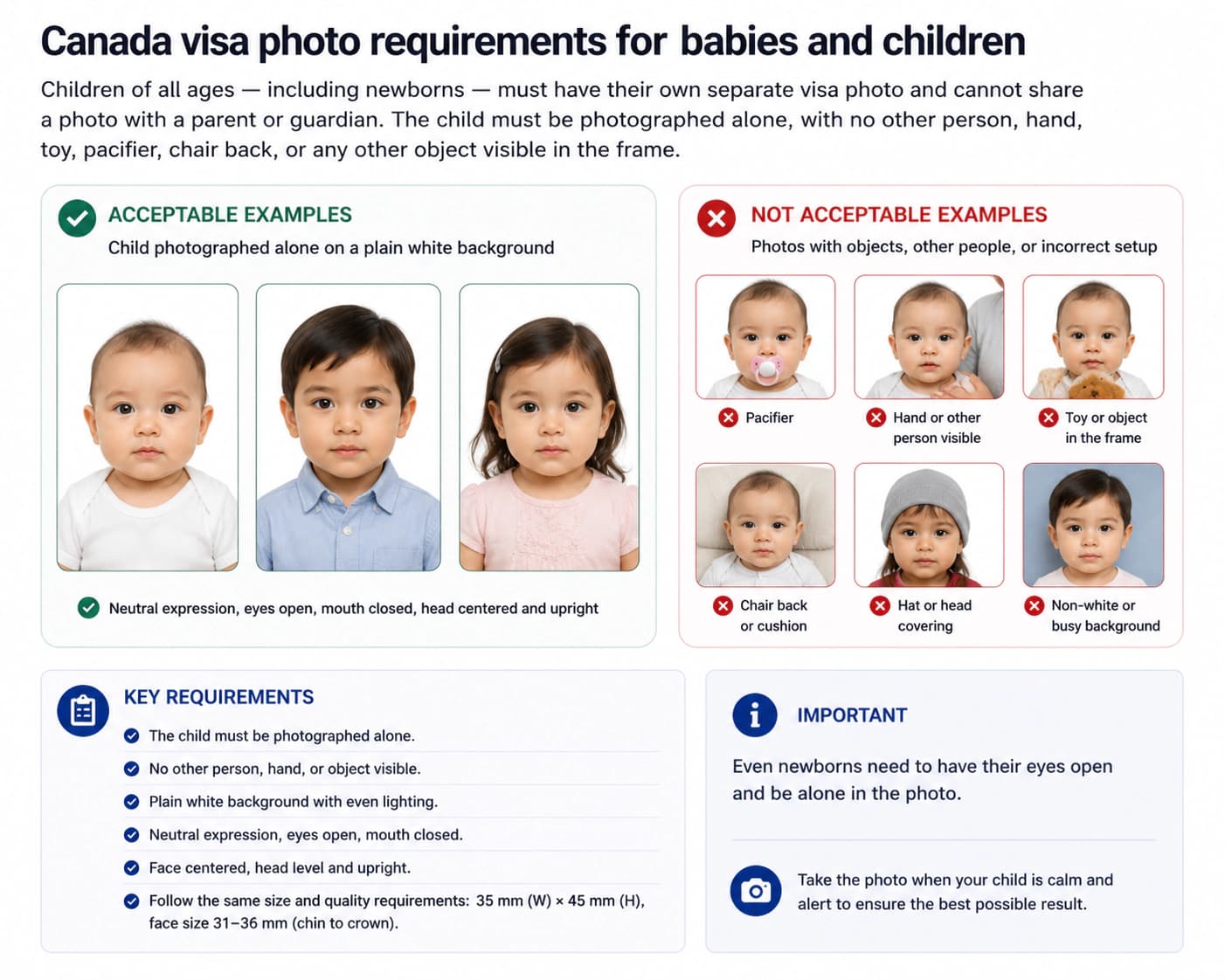
For very young infants who cannot support their own head, lay them on a white sheet on a flat surface and photograph directly from above. Ensure the white sheet fills the entire background without shadows or creases. For children aged 3 and over, the full standard requirements apply: mouth closed, eyes open, neutral expression, plain white background. For infants under 3 years of age, a slightly open mouth is generally accepted.
Religious head coverings in Canada visa photos
Religious head coverings are permitted provided they are worn daily for religious reasons and meet all of the following conditions: the covering must be plain material with no patterns; your full face must remain visible from the bottom of the chin to the top of the forehead; both side edges of the face — including the outer eye corners — must be visible; and the covering must cast no shadows on your face or on the white background.
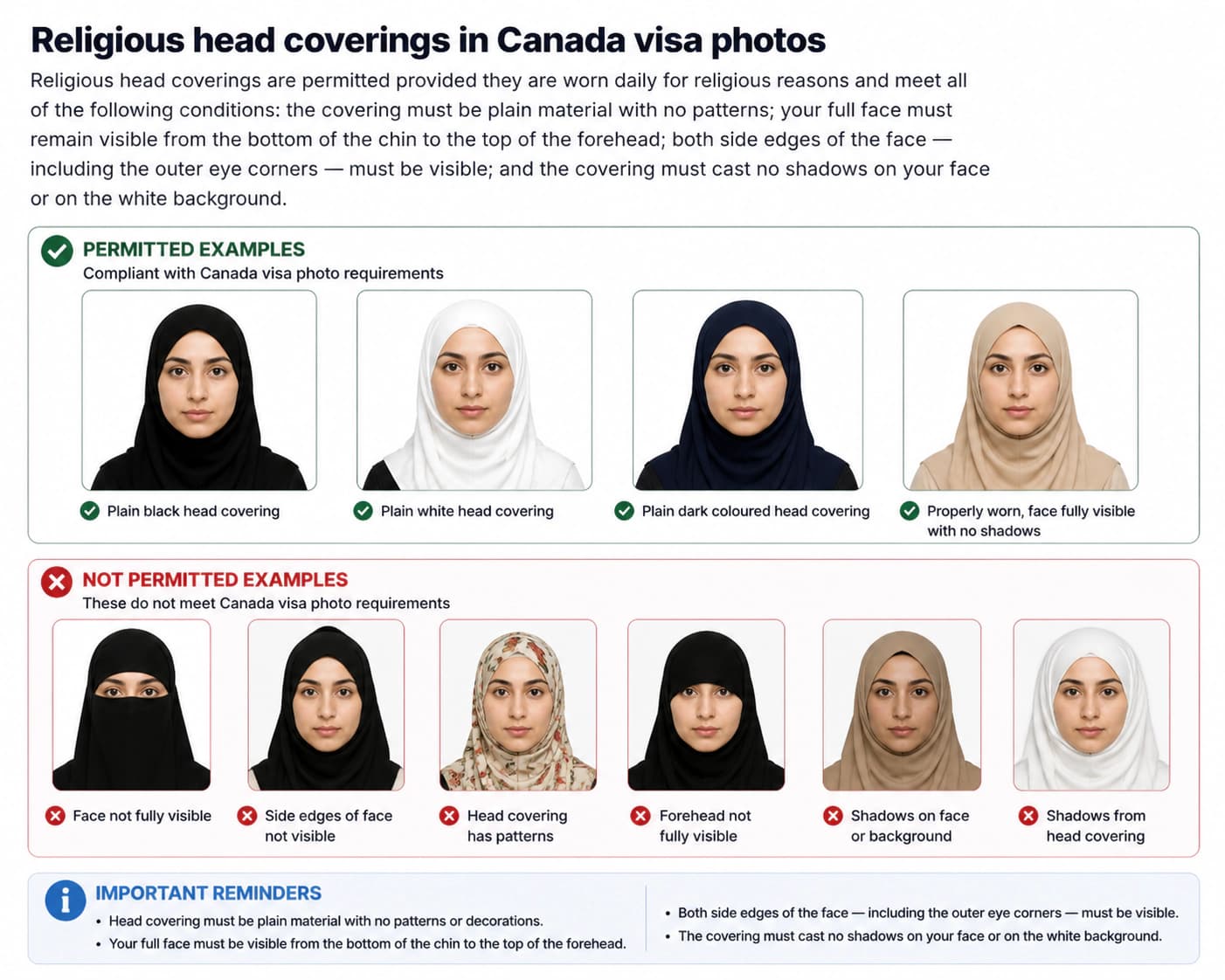
Fashion hats, beanies, caps, and headwear worn for non-religious reasons are not permitted. Medical head coverings — for example following surgery — are accepted with an accompanying signed medical certificate from a registered practitioner.
Official sources
These pages are the authoritative references.
Frequently asked questions: Canada visa photo 2026
What is the Canada visa photo size requirement in 2026?
Canadian visa photos must be 35 mm wide by 45 mm high. Your face from the bottom of the chin to the top of the head (crown) must measure between 31 mm and 36 mm. For online applications through the IRCC portal, upload a JPEG file that is at least 420 × 540 pixels and under 4 MB. The background must be plain white.
What is the Canada visa photo size in pixels?
IRCC requires a minimum of 420 × 540 pixels for online submissions. There is no stated maximum pixel count, but the file must be under 4 MB. Higher resolution (such as 1200 × 1600 px) is recommended for better quality, provided the file size stays below 4 MB.
What is the Canada visa photo size in cm and inches?
The photo must be 3.5 cm wide by 4.5 cm high. In inches, that is approximately 1.38 inches wide by 1.77 inches high. This is a portrait format — do not use the 2 × 2 inch (51 × 51 mm) square format used for US visas.
Does Canada accept a 2×2 inch photo for a visa?
No. A 2 × 2 inch (51 × 51 mm) square format is the US visa standard. Canadian visa photos must be 35 mm wide by 45 mm high, which is a portrait format and not square. Using a 2 × 2 inch photo will result in rejection.
Can the Canada visa photo background be off-white or light grey?
No. IRCC strictly specifies a plain white background. Off-white, cream, light grey, and any tinted backgrounds are not accepted. The background must be pure white with no shadows, patterns, or gradients. This differs from some other countries that accept light grey.
Can I wear glasses in a Canada visa photo?
No. Glasses have not been permitted in Canadian visa or passport photos since 2020. IRCC removed all exceptions to simplify processing and improve biometric accuracy. Regardless of the reason for wearing glasses, they must be removed before taking the photo.
Can I smile in a Canada visa photo?
No. You must maintain a neutral expression with your mouth closed and eyes fully open. Smiling, frowning, raised eyebrows, and any other expression will be detected by automated face-recognition software and will trigger rejection of your application.
How recent must a Canada visa photo be?
The photo must have been taken within the last 6 months and must accurately reflect your current appearance. If your appearance has changed significantly — for example due to surgery, significant weight change, or a major change in facial hair — you should use a new photo.
Are Canada tourist visa and study permit photo requirements different?
The core photo specifications are the same across most IRCC applications: 35 × 45 mm print or 420 × 540 px digital minimum, plain white background, neutral expression, and no glasses. Always check the specific requirements on the portal page for your application type, as individual checklists may have additional instructions.
Can I use a photo taken on my phone for a Canada visa?
Yes, provided the photo meets all IRCC requirements: plain white background, minimum 420 × 540 pixels, JPEG format under 4 MB, correct face proportion, neutral expression, and no glasses. Use a second person to take the photo rather than a selfie for better framing and sharpness.
Should a Canada visa photo be matte or glossy?
IRCC guidance recommends professional photo paper for printed submissions, which is typically glossy or semi-gloss. For digital submissions via the online portal, paper finish is irrelevant as only the JPEG file is submitted.
What should I wear for a Canada visa photo?
Wear everyday clothing that contrasts clearly with the white background. Avoid white or very pale tops that will blend into the background. Do not wear uniforms, camouflage, or costumes. Modest religious dress is permitted provided your full face from chin to crown remains visible.
Are religious head coverings allowed in a Canada visa photo?
Yes, provided the covering is worn for religious reasons, is plain material without patterns, casts no shadows on your face or the white background, and your full face from chin to crown — including both side edges — remains visible.
What are the Canada visa photo requirements for babies and children?
Children of all ages, including infants, need their own separate photo. No other person, hand, toy, pacifier, or object should appear in the frame. For very young infants who cannot support their head, lay them on a white sheet on a flat surface and photograph from directly above. The standard expression and background rules apply; for very young infants a slightly open mouth is generally accepted.
Can I retouch or edit my Canada visa photo?
No. Any form of digital retouching or editing is not permitted. This includes background removal and replacement, skin smoothing, blemish removal, brightness or contrast adjustments, and any filters. The photo submitted must be the original, unaltered digital file.
What is the file size limit for a Canada visa photo uploaded to the IRCC portal?
The file must be a JPEG under 4 MB and at least 420 × 540 pixels in resolution. Files that exceed 4 MB will not upload. Files below the minimum pixel dimensions will be rejected. Check both the file size and pixel dimensions before submitting.
Ready to prepare your Canada photo?
Upload your original image and our tool will automatically crop to 35×45 mm, verify the plain white background, check 420×540 px minimum resolution, and export to JPEG.
Canada Visa Photo Maker